
The hardest part of exercise is often walking into the room
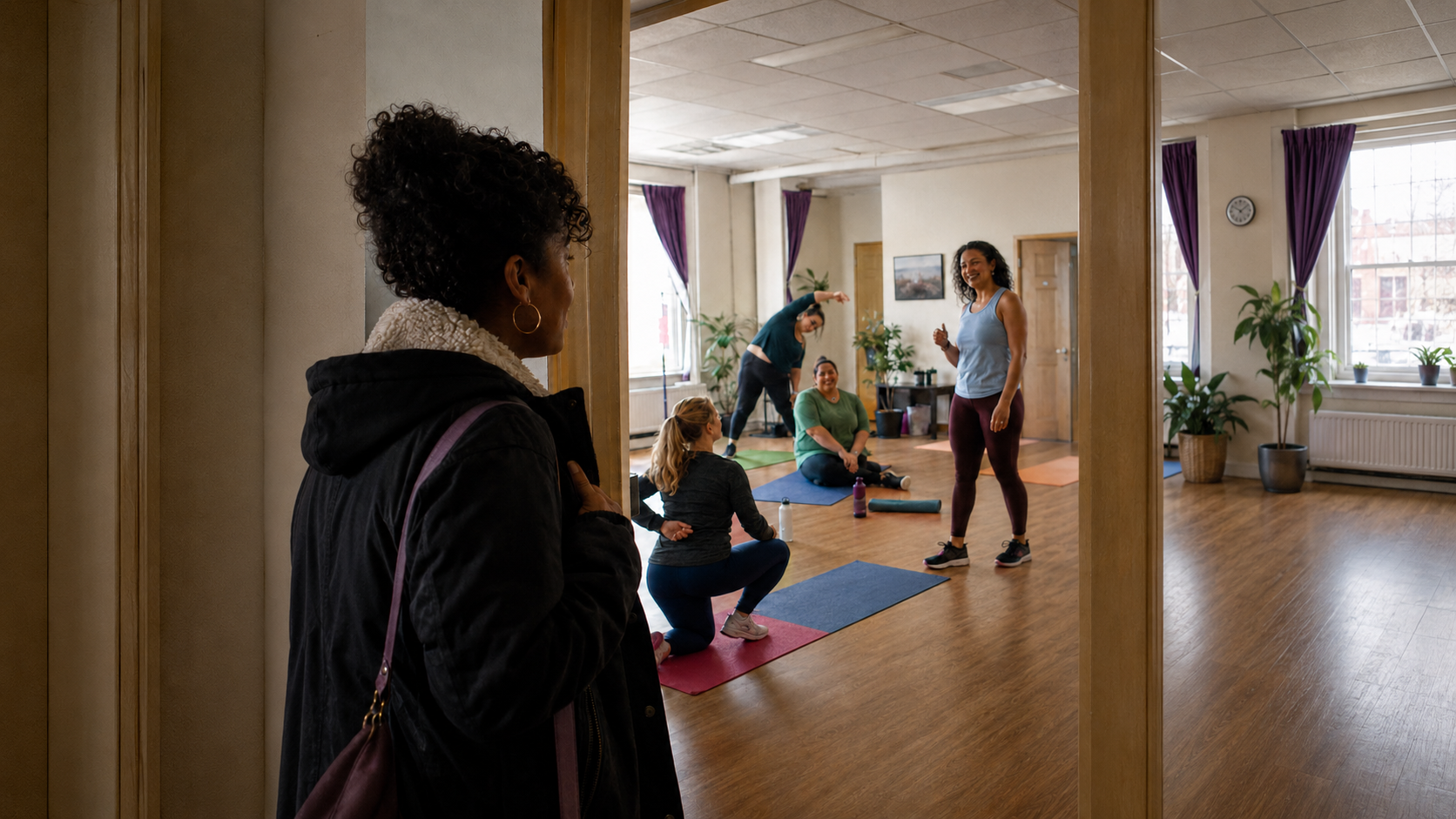
She’s been thinking about it for three weeks. She looked up the class online. She checked the times twice, maybe three times. She even told her sister she was going. And then, on the morning, she found a reason not to. It wasn’t laziness. It wasn’t that she didn’t want to go. It was something harder to name: a feeling that the room might not be for her.
This is where the real conversation about women and exercise needs to begin. Not with motivation. Not with the science of habit formation, or the benefits of raising your heart rate, or how to fit movement into a busy schedule. With the door. With the particular weight of walking into a room full of strangers and trying to work out, in the first few seconds, whether you belong there.
What the fitness world gets wrong
The mainstream fitness industry has spent decades treating the barrier to exercise as a problem of willpower. You just need to want it badly enough. You just need to commit. The message is everywhere: in the before-and-after photos, in the language of transformation, in the way classes are sold as journeys you take when you’re finally ready to change.That framing puts the problem inside the woman. Her motivation. Her discipline. Her relationship with her own body. And for some women, in some circumstances, that framing might even be partially true. But for a great many women, and particularly for women who have spent their lives in spaces that weren’t designed with them in mind, the barrier isn’t internal. It’s the room itself.
The class where the playlist is someone else’s idea of energising. The instructor who gives a modification and looks surprised when it’s needed. The mirror wall. The changing room. The particular way a space can feel unwelcoming without anyone saying a single unkind word. A woman can walk in, scan the room in three seconds, find no face that looks like hers, and already be calculating her exit before she’s taken her coat off.
That calculation is not irrational. It is sensible. It is based on experience.
The weight of the first time
There’s something specific about being new in a room built around movement. In a lot of social situations, you can hold back, observe, find your footing gradually. In an exercise class, you’re expected to perform almost immediately. You’re wearing clothes that may feel exposing. Your body is doing things in public. And if the class assumes a certain level of fitness, a certain body type, a certain cultural comfort with being watched and evaluated, you feel every one of those assumptions in real time.For women who’ve had difficult experiences with their bodies, whether through illness, pregnancy, injury, or simply years of being told their body is something to be managed rather than lived in, that first class is carrying a lot of history. The woman at the back who keeps her cardigan on for the first half hour isn’t being difficult. She’s being careful. She’s protecting something.
And for Black, Asian and minority ethnic women, there are layers that the mainstream conversation about exercise rarely touches. The hijab, and whether the room will be women-only, and whether that was actually guaranteed or just implied. The hair, and what this class will do to it, and whether that’s even a small consideration worth having. The instructor who has never had to think about how to modify a movement for a body that doesn’t match the default. The sense, built up over years, that wellness spaces were designed for a particular kind of woman, and that kind of woman is not you.
None of this is dramatic. It’s just the quiet arithmetic that some women do before they ever get to the question of whether they’ll enjoy the class.
Why belonging comes before motivation
The research on exercise adherence, the question of why people start and then stop, tends to focus on individual factors: time, cost, confidence, social support. These matter. But there’s something underneath all of them that gets less attention, which is the felt sense of whether a space was built with you in mind.Belonging isn’t a feeling you manufacture. It’s not something a motivational poster on the wall produces. It comes from small, specific things: an instructor who uses your name and remembers it the following week. A room where the range of bodies present is genuinely wide. A class where no one raises an eyebrow when you need to sit down for a minute. A space where you don’t have to explain yourself, or shrink yourself, or perform a version of confidence you don’t actually feel yet.
When those things are present, something shifts. Women come back. Not because they’ve resolved their relationship with exercise, or conquered their self-doubt, or found their motivation. But because the room felt like it was expecting them. That’s a different thing entirely, and it’s more powerful than almost anything else.
When those things are absent, no amount of encouragement closes the gap. You can tell a woman she’s welcome. You can tell her the class is for everyone. But if she walks in and the room doesn’t feel like it means that, she already knows.
The cost question, and what it actually costs
Cost is real and it deserves to be named plainly. Gym memberships, fitness classes, activewear, the travel to get there: these add up quickly, and for women managing tight budgets, often alongside caring responsibilities and irregular work, the financial barrier to exercise is not a minor inconvenience.
It’s a wall.The fitness industry has responded to this largely by creating a two-tier system: expensive, well-resourced spaces for those who can afford them, and cheaper options that are often less welcoming, less well-staffed, and less likely to feel like somewhere you’d want to spend an hour of your limited free time. The women most likely to benefit from accessible movement are often the ones with the least access to it. That’s not a personal failing. It’s a structural one.
Cost also intersects with time. The school run that ran over. The shift that changed. The relative who needed something. Women, and particularly women who carry the majority of caring and domestic labour in their households, often have to negotiate their own time in ways that men simply don’t. When the window for a class is narrow and something gets in the way, it’s easy to feel like the opportunity has passed, not just for today, but indefinitely. Like the door has quietly closed again.
What actually helps
What helps is not a pep talk. It’s not a list of tips for getting out of your own way. What helps is a room that was genuinely designed with a specific woman in mind: her schedule, her budget, her cultural context, her body, her history with exercise, and whether she’s ever felt welcome in a room like this before.It helps when cost is addressed directly, not as an afterthought, but as a central part of how a programme is built. When the class is women-only, not as a marketing point, but because some women need that in order to move freely. When the instructor doesn’t assume everyone’s body works the same way, or that everyone has the same relationship to being watched. When showing up quietly, without performing enthusiasm, is enough.
It helps when the room has faces in it that look like yours. When the music occasionally sounds familiar. When no one makes you feel like you’ve arrived at someone else’s party.
And it helps, sometimes more than anything else, when someone expected you back. Not in a pressuring way. Just: you were thought of. There’s a spot. The door is already open.
The door is the work
The hardest part of exercise, for a lot of women, is not the exercise. It’s the decision to walk into a room that might not have been built for you, and try anyway. That takes something. It takes more than motivation, more than free time, more than a good pair of trainers. It takes a reasonable belief that the room will be worth it.Making that belief possible is not the woman’s job. It’s the job of everyone who designs, runs and holds those spaces. The question worth asking is not why women don’t show up. It’s whether the room gave them a real reason to.